

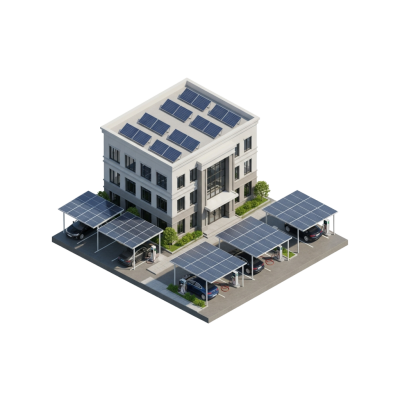

A: A PPA is a financial arrangement where a third-party developer owns, operates, and maintains the solar system installed on your property. You agree to purchase the electricity generated by the system at a set rate, which is typically lower than your current utility rate. This allows your organization to enjoy the financial and environmental benefits of solar energy with little to no upfront capital investment.
A: Because non-profits generally cannot take advantage of federal tax credits for solar equipment, a PPA allows them to partner with a tax-paying entity (the developer) that can monetize those incentives. The developer passes these savings on to you in the form of lower, predictable electricity rates, making solar accessible without the need for large upfront project funding.
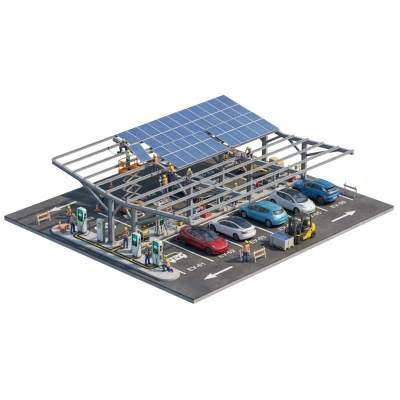
A: A solar+EV charging PPA combines onsite solar generation with electric vehicle charging infrastructure into one seamless agreement. The solar system powers the EV chargers and your facility, often reducing peak demand charges and energy costs. We manage the design, installation, and ongoing maintenance of both the panels and the charging stations, providing you with a turnkey sustainability solution.
A: One of the primary benefits of a PPA is price certainty. Your contract will feature either a fixed rate for the duration of the agreement or a pre-determined, modest annual escalator. This protects your organization from the volatility and unpredictable price hikes common with traditional utility providers.
A: Under a PPA, the system owner (the developer) is responsible for all operations, maintenance, monitoring, and repairs for the life of the contract. You do not need to worry about the technical performance of the panels or the chargers; we ensure the system operates at peak efficiency to maximize your energy output.
A: When your contract term concludes, you typically have three options: you can renew the agreement at a lower rate, have the developer remove the equipment, or exercise an option to purchase the solar system and/or EV charging equipment at its fair market value to own it outright.
A: Our solar agreements typically include performance guarantees that ensure the system meets specific production targets over the life of the contract. We utilize advanced remote monitoring software to track real-time output 24/7. If the system underperforms due to equipment failure or technical issues, we are responsible for diagnosing and resolving the problem at no additional cost to you, ensuring your energy savings remain consistent.
A: We initiate all projects with a rigorous feasibility study. This includes a structural analysis of existing roof systems (or geotechnical testing for ground mounts), an assessment of the electrical service entrance capacity, and a review of the existing switchgear to ensure compatibility with modern grid-tied inverters and potential EV charging integration.
A: Yes. We provide high-fidelity energy modeling using industry-standard software. Our simulations account for site-specific TMY (Typical Meteorological Year) data, localized shading profiles, array orientation, module degradation rates, and system losses (soiling, electrical, and thermal) to provide accurate P50 and P90 production estimates for financial modeling.
A: We handle the full life cycle of the interconnection application. This includes preliminary hosting capacity analysis, the submission of all required technical drawings (Single-Line Diagrams), and ongoing coordination with utility engineers. We prioritize identifying interconnection risks early in the development stage to avoid costly late-stage system design changes.
A: We maintain a stringent quality-assurance procurement policy. We source Tier-1 equipment that carries long-term performance warranties and bankable insurance backings. We provide full traceability, including factory test reports (EL imaging, flash data) and, for EV infrastructure, OCPP (Open Charge Point Protocol) compliance documentation to ensure future-proof network integration.
A: Safety is our baseline. Our construction management includes site-specific Health, Safety, and Environmental (HSE) plans that exceed local OSHA requirements. We conduct regular field audits throughout the construction process and ensure that all installations are fully compliant with the latest NEC (National Electrical Code) standards, local building codes, and AHJ (Authority Having Jurisdiction) requirements.
A: Our commissioning process is extensive. Beyond basic startup, we perform IV-curve tracing, string-level voltage and insulation resistance (Megger) testing, and grounding continuity verification. We then conduct a full synchronization test with the utility, followed by a formal performance test (following IEC 62446 standards) to confirm the system meets the modeled PR (Performance Ratio) before the Commercial Operation Date (COD).
A: We deploy enterprise-grade, cloud-based monitoring solutions that provide granular, real-time data at the inverter and string-combiner level. Our O&M team utilizes these analytics to trigger predictive maintenance, such as automated alerts for inverter derating, soiling losses, or module-level anomalies, ensuring the system maintains its performance guarantee throughout the PPA term.