
Sustainable Capital Finance (SCF) recently celebrated the completion of several municipal solar projects for the City of San Joaquin, California. Many small to mid-sized cities today are caught between rising utility rates and fixed tax revenues. However, these communities still want to provide modern, sustainable infrastructure for their residents. For San Joaquin, the solution came through a strategic partnership and specialized financing. By using a Power Purchase Agreement (PPA), the city was able to install nearly 200 kW of clean energy across three unique sites. This project serves as a prime example of how local governments can modernize without financial risk.
The Challenge of Funding City Infrastructure
Most local leaders understand the benefits of renewable energy. In fact, municipal solar projects are often high on the priority list for city managers. The primary hurdle, however, is almost always the upfront cost. Traditional solar installations require significant capital. Because cities must prioritize essential services like police and fire protection, solar often gets delayed.
Furthermore, many municipalities are wary of taking on new debt. Issuing bonds can be a slow and expensive process. Additionally, because city governments are tax-exempt, they cannot naturally take advantage of the federal tax credits that make solar affordable for private businesses. Consequently, many cities feel stuck with high utility bills that they cannot control. Fortunately, the PPA model was designed specifically to bridge this gap for the public sector.
Why San Joaquin Chose the PPA Model
A Power Purchase Agreement allows a city to host a solar system that is owned and maintained by a third party like SCF. In this arrangement, the city does not pay to build the system. Instead, the city simply agrees to buy the electricity generated by the panels at a lower rate than the utility charges. Therefore, the city saves money from the very first day the system is turned on.
For the City of San Joaquin, this was the perfect fit. They needed to lower their operational costs without dipping into their general fund. By partnering with SCF and Vista Solar, the city moved forward with 100% financed municipal solar projects. This allowed the city to keep its capital reserved for other community improvements. Moreover, the city was shielded from the technical risks of solar ownership, such as equipment repairs or system performance monitoring.
A Deep Dive into the San Joaquin Multi-Site Strategy
What makes the San Joaquin project unique is its technical diversity. Rather than a single large array, we developed three separate systems across the city. This strategy allowed the city to offset energy costs for different departments simultaneously.
The project consists of three distinct installation types:
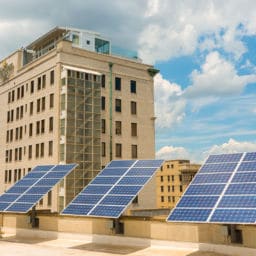
- A Ballasted Roof Mount: This system was installed on a flat roof. It uses weights instead of bolts to stay in place. Consequently, there was no damage to the building’s roof membrane.
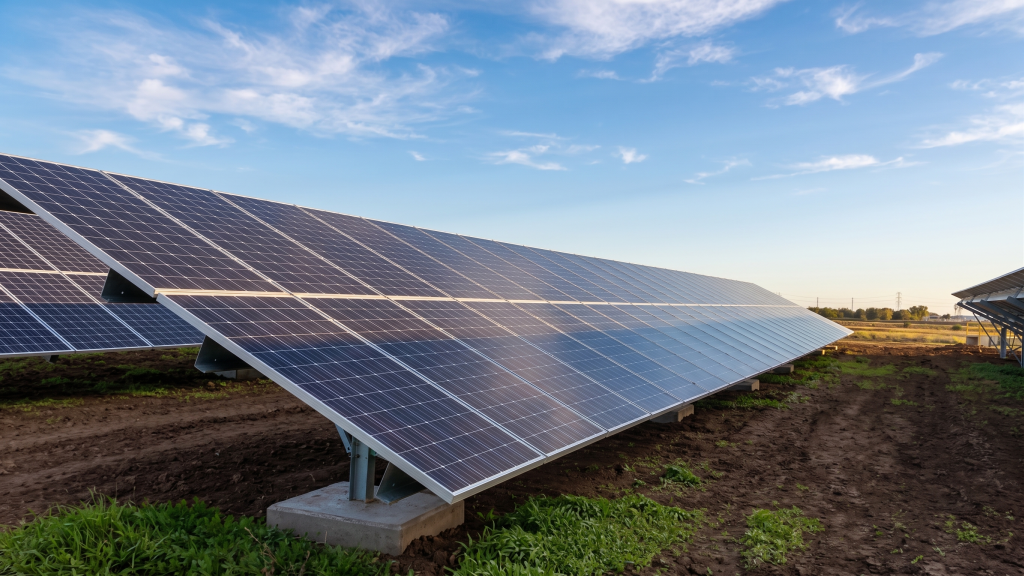
- A Ground-Mounted Array: This system was placed on open land within the city. It turned a previously unused parcel into a valuable energy-generating asset.
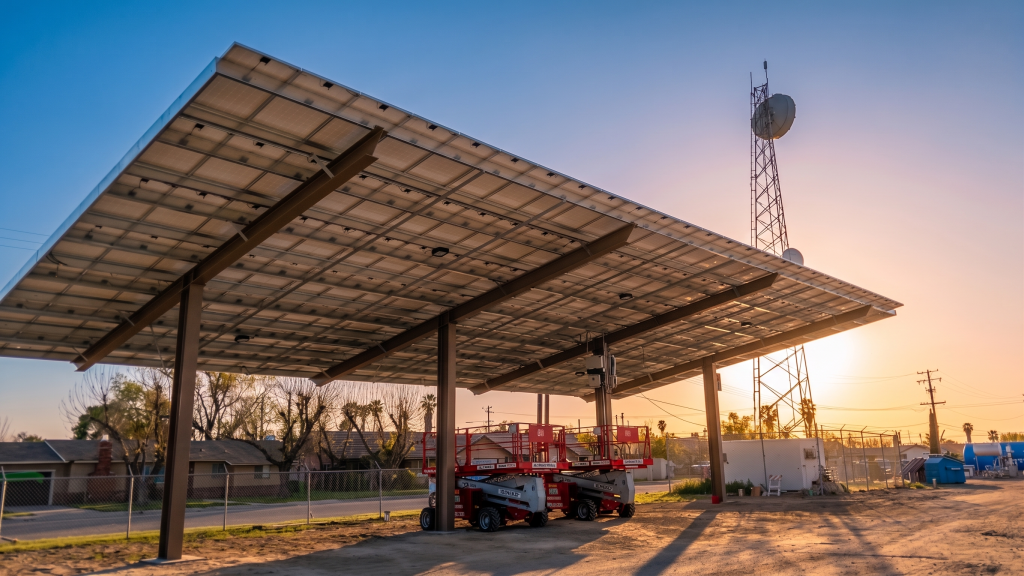
- A Solar Carport: This structure provides shade for city vehicles in a busy parking lot. In addition to creating power, it protects the city’s fleet from the California sun.
This variety proves that municipal solar projects can be adapted to fit any landscape. Whether a city has open land, available roof space, or just a parking lot, there is a solar solution that can work.
Stewardship and the Impact of the IRA
Beyond the financial savings, these municipal solar projects represent a commitment to stewardship. Local governments have a responsibility to lead their communities toward a cleaner future. By choosing solar, San Joaquin has reduced its carbon footprint significantly. In fact, this project shows residents that their leaders are thinking about the long-term health of the environment.
Furthermore, the timing of these projects is critical. The Inflation Reduction Act (IRA) has introduced “Direct Pay” options for tax-exempt entities. This means that cities can now receive cash incentives for solar that were once reserved only for corporations. This new policy makes the math for municipal solar projects even more attractive. As a result, more cities are looking at the success of San Joaquin as a roadmap for their own energy transitions.
Key Lessons for Other Municipalities
The success in San Joaquin offers several lessons for other local governments. First, it is important to look at your entire property portfolio. You do not need one massive site to make solar work. Multiple smaller systems can be bundled together to achieve your goals.
Second, choosing the right partner is vital. Municipal solar projects involve complex legal and utility requirements. Working with a partner like SCF ensures that these details are handled professionally. We manage the “red tape,” from geotechnical surveys to interconnection paperwork. This allows city staff to focus on serving their citizens while we manage the energy infrastructure.
Frequently Asked Questions about Municipal Solar
Does the city have to hire staff to manage the panels? No. One of the biggest benefits of a PPA is that the owner (SCF) handles all maintenance. If a panel breaks or needs cleaning, we take care of it. This ensures the system always runs at peak efficiency without adding work for the city’s public works department.
How does solar help with city budgeting? Standard utility rates can go up every year. However, a solar PPA provides a fixed, predictable rate for power. This makes long-term budgeting much easier for city finance directors. It eliminates the “surprise” of a high energy bill during a heatwave.
Are municipal solar projects only for sunny states? While California is a leader in solar, these projects are successful all over the country. Federal incentives and falling equipment costs have made solar viable in almost every region. If your city has high energy rates, solar is likely a winning investment.
Can we combine solar with EV charging? Absolutely. Many cities are now adding EV charging stations to their solar carport projects. This provides a modern amenity for residents and helps the city transition its own fleet to electric vehicles. In addition, the solar panels can provide the clean energy needed to power the chargers.